
Replace the Phone with a Chair
More and more schools are deciding that the answer to the smartphone problem is to take the smartphone away. England has introduced statutory guidance requiring schools to prohibit mobile-phone use throughout the school day from September, while countries including Norway and the Netherlands have also introduced increasingly strict restrictions.
Social comparison, fear of missing out, bullying, body-image pressures, and the expectations of others have always made adolescence a roller coaster. And the smart phone has put a rocket engine on the back of the train. So arguably, banning phones is a reasonable attempt to solve a genuine problem.
But maybe we are focussing on the wrong end of the problem. We are telling young people to stop doing something instead of showing them what we actually want them to do.
A smartphone provides, amongst other things, connection, agency, autonomy, entertainment and positive emotions. These are all things we want young people to experience in school. The challenge is to provide them in ways that are more real, more social and more active than sitting curled up around that dark mirror.
Surprisingly, a chair can help.
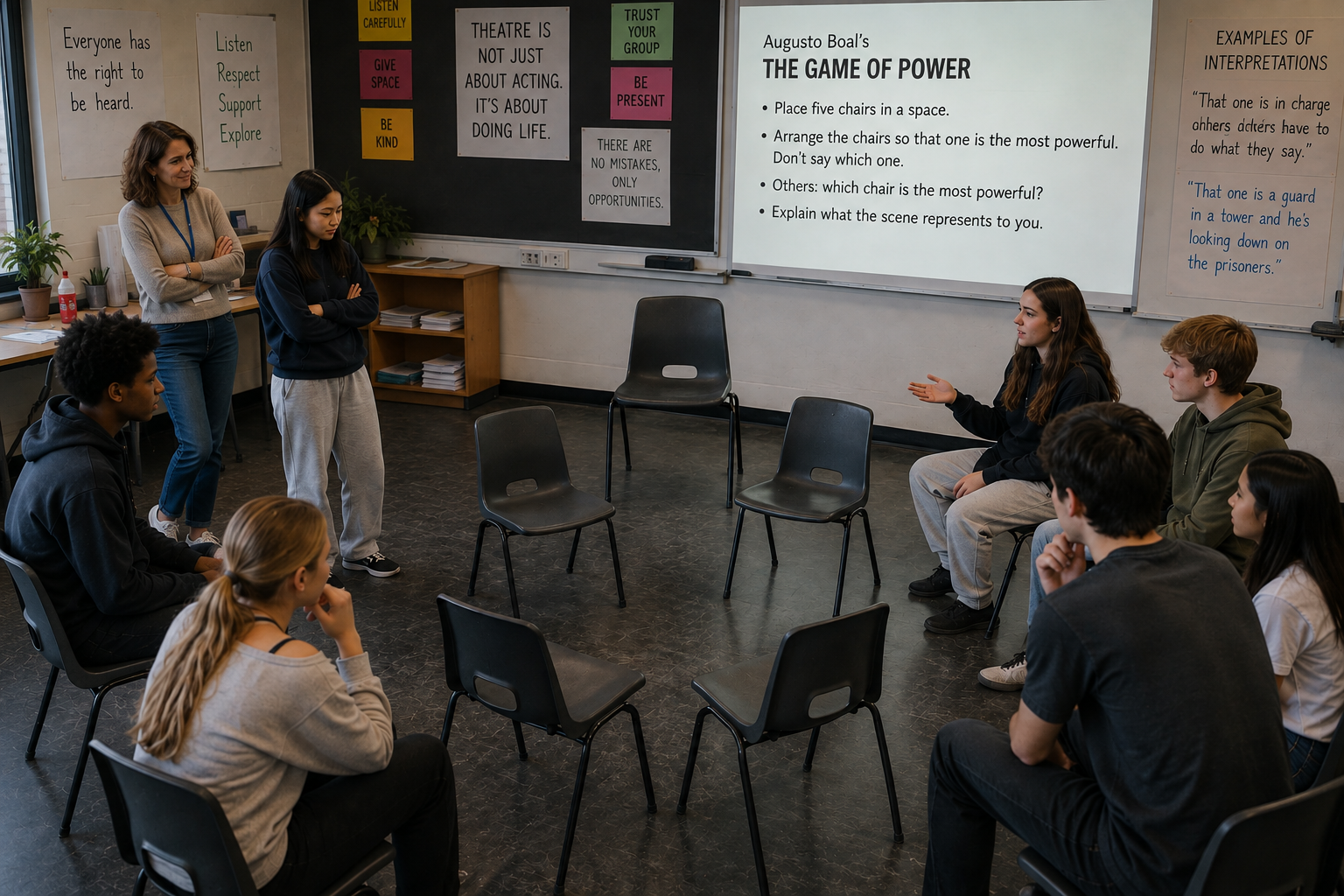
Take Augusto Boal's ‘Game of Power’. Five chairs are placed in a space. A student is invited to arrange them so that one appears to be the most powerful. They don't explain their arrangement. Instead, the rest of the group looks at the scene and decides what they think it represents. Perhaps one chair is clearly in charge and the others have to do what it says. Another student suggests it becomes a guard in a tower looking down on prisoners. There is no single correct answer.
The students have to look, interpret, imagine, discuss and listen to other perspectives. They have to make decisions and defend their ideas. They are using their bodies, their voices and their imaginations. And, importantly, they are doing it, actively, together.
It is a very simple activity. But mindfully executed, it provides some of the things young people are trying to find through their phones: agency, connection, autonomy, curiosity, positive emotion and belonging. And, with a little adaptation, it can be applied to engage students in a wide variety of subjects:
- Napoleon's strategic rise to power
- The constellation of individuals in a troop of baboons
- The interdependence of species within an ecosystem
- The competing interests in a climate-change debate
Drama games are one way to replace phones in the classroom. So are outdoor challenges, collaborative problem-solving, making things, performing, exploring, playing and simply giving young people opportunities to talk to one another without an algorithm deciding what comes next.
None of this means that phones are inherently bad, or that every lesson should become an active workshop. But if we are going to take something away, as so many education authorities are now doing with smart phones, perhaps we should first know what we are going to put in its place.