
Where is the best place to learn?
It’s the middle of August and much of the Northern Hemisphere is having to cope with yet another heat wave. Schools in many countries are preparing to start a new academic year, and the heat gives us a reason to think about where learning might best take place.
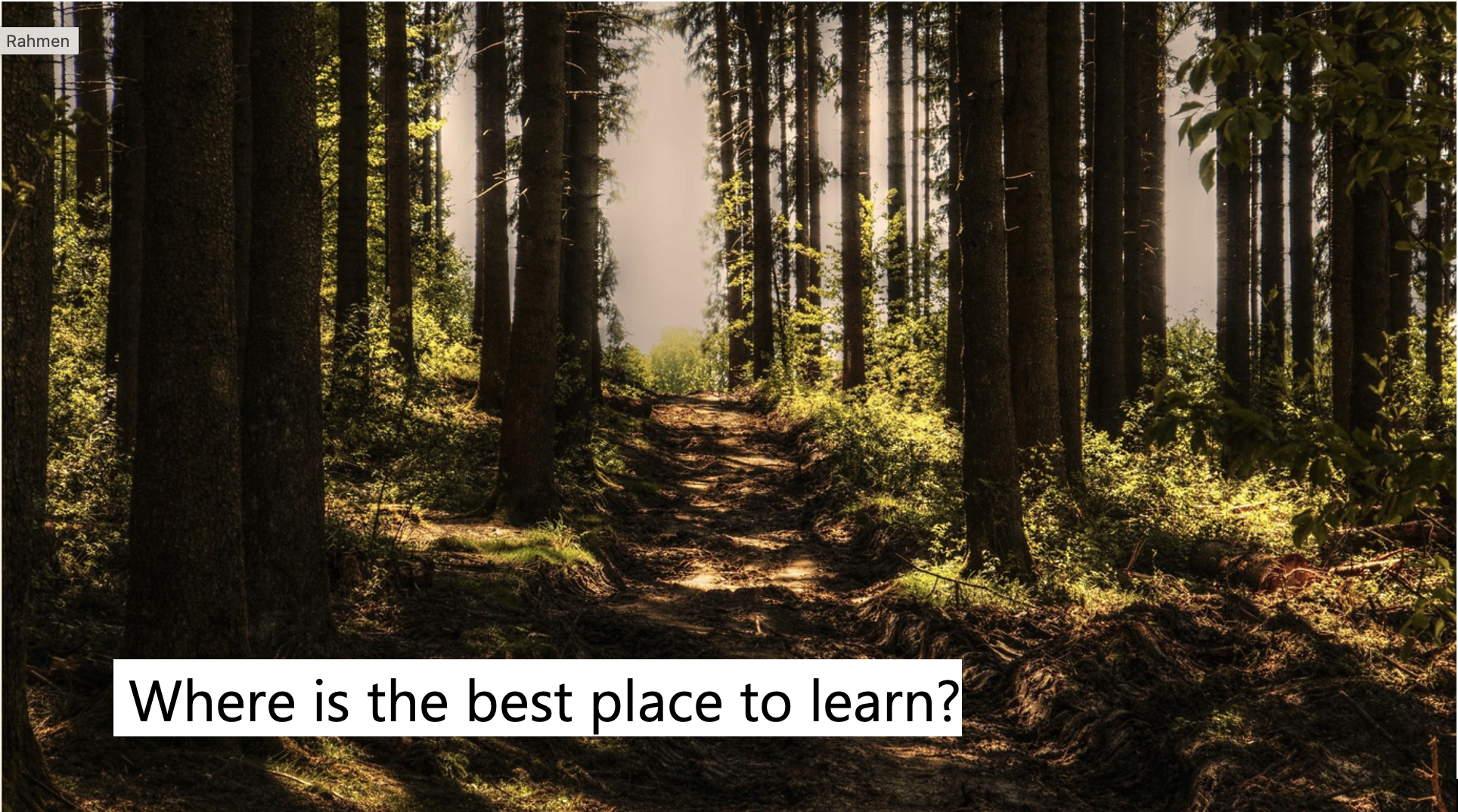
I am not suggesting we abandon the classrooms before the students know where to hang their bags. Nor that every lesson should become an outdoor adventure. But if the temperature in the classroom itself becomes a distraction and there is some nature nearby, perhaps there is a perfectly good classroom already waiting for us under the shade of the trees.
There is something different about learning in a forest or near the water. The environment itself becomes part of the experience. The changing light, moving leaves, insects, birds, smells and textures all provide illustration for the lesson’s topic.
The forest isn't a magic classroom and putting a lesson under a tree doesn't automatically make it a good lesson. But perhaps we sometimes place too much emphasis on what we teach and not enough on the conditions that allow learning to take place. A child who is more engaged, more curious, happier and more willing to work with others is in a rather good position to learn.
The possibilities are endless.
- An English lesson where a story or poetry is read beneath the trees rather than from a screen.
- Science where the subject matter is actually moving around you.
- Mathematics where the geometry is not just drawn on a worksheet but can be found everywhere the students look.
- A group problem-solving activity where students have to communicate, negotiate and perhaps even disagree with each other in order to succeed.
None of this is particularly revolutionary – teachers have been taking children outside for generations. But it is reassuring when science catches up with what teachers have known intuitively for years.
The research into outdoor and nature-based learning suggests that the benefits may extend well beyond academic learning. Engagement, wellbeing, social relationships and a sense of agency can all flourish when students learn in a natural setting.*
After a long summer, as teachers prepare classrooms and students prepare themselves for another year of lessons, tests, timetables and targets, perhaps we could occasionally begin with a different question.
Not: “How do we get them to concentrate after the summer break?”
But: “Where would be the best place for them to learn this?”
Sometimes, especially when the sun is beating down, and the classroom is sweltering, the answer might simply be - under the trees.
* Research: Frontiers in Public Health (2022) – Natural outdoor learning and its effects on children's learning, development and wellbeing: a systematic review of the literature.